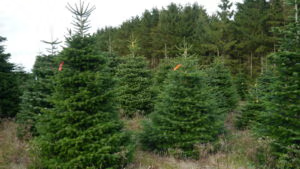
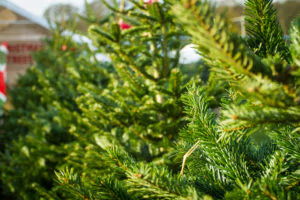
Real Christmas trees carry a wealth of environmental benefits. These ‘young’ forests provide important habitats for animals and insects that couldn’t survive in simple grass meadows. Couple this with responsible disposal (more info here) and the ENTIRE life cycle of your tree carries a CO2 footprint similar to that of a single bottle of wine.
Carbon Footprint and Disposal
The end-of-life disposal method is the single largest variable in a real Christmas tree’s carbon footprint. Because the carbon stored in the wood was absorbed from the atmosphere during its growth, aerobic decomposition is entirely carbon-neutral.
● Home Chipping / Composting (Best): ~0 kg CO2e. Yes that says zero! This guarantees aerobic decomposition and requires no industrial transport or processing. The total cradle-to-grave footprint (accounting for cultivation and retail logistics) drops to roughly 1.5 to 2 kg CO2e, similar to a 100g bar of dark chocolate. (Watch our how to video here).
● Council, private or green bin Recycling (Good): ~3.5 kg CO2e. The biological process is identical to home composting, but the footprint increases due to the diesel collection lorries and heavy industrial chippers required.
● Landfill (Worst): ~16 kg CO2e. Burying the tree under tons of waste forces anaerobic (oxygen-free) decomposition, releasing methane—a greenhouse gas 25 to 80 times more potent than carbon dioxide.
Real vs. Artificial:
A typical 2-metre artificial plastic tree carries a carbon footprint of approximately 40 kg CO2e, driven by petroleum extraction, PVC/PE manufacturing, and international shipping.
To determine which is more sustainable, it depends entirely on how the real tree is disposed of:
● Artificial vs. Home Composting: An artificial tree must be kept for 16 to 20+ years before its per-year emissions drop below the 1.5 to 2 kg CO2e footprint of buying a real tree annually. (Watch our how to video)
● Artificial vs. Council Recycling: An artificial tree must be reused for 10 to 12 years to break even.
● Artificial vs. Landfill: An artificial tree breaks even after 2.5 to 3 years of use.
Ecological Benefits: The “Young Forest”
A Christmas tree plantation operates as an essential “early successional habitat.” Because sites are often managed on staggered 8-year growth cycles—such as planting 15,000 saplings annually across a 3.5-acre field—the land avoids the shock of total clear-cutting.
This creates a dynamic, multi-layered mosaic of vegetation. The varied heights provide ideal scrubland-style nesting and foraging for declining bird species like linnets and yellowhammers.
Because the soil is not tilled annually like an arable crop, complex fungal networks and micro-fauna thrive undisturbed for years.
Natural Flood Management
Permanent evergreen crops provide year-round hydrological buffering, acting as a natural sponge during extreme winter weather:
● Canopy Interception: Dense conifer needles catch heavy winter downpours (when deciduous trees are bare), shattering the kinetic energy of the rain and allowing much of it to evaporate before hitting the ground.
● Deep Infiltration: The undisturbed, long-term root systems create deep macropores in the soil, allowing water to percolate into the water table rather than running off the surface.
● Surface Roughness: Maintained understory grasses create ground-level friction that slows overland flow and traps sediment.
Transport Efficiency: Road vs. Sea Freight
The Tree Amigos have our own plantation in England, we also collaborate with other growers in the UK, Ireland and Denmark.
When analysing supply chains and the environmental impact of a trees origins, the results are counterintuitive, as the mode of transport matters more than the raw mileage.
As a result, many trees arriving via sea freight in the UK from Denmark carry a significantly lower co2 footprint than trees arriving from Inverness – one of the countries largest Xmas tree production areas.
Articulated HGVs emit roughly 50 to 70 grams of CO2e per tonne-km, while RoRo sea freight ferries emit only 10 to 15 grams per tonne-km. As Danish trees spend so much of their journey as a maritime crossing to reach our farm, we have calculated the CO2e to be roughly half that of trees sourced from the highlands.